From manual review to AI-assisted processing on a high-volume SME funding programme
Cost per case down 54% Year 1 → Year 2; team −44%; cases per FTE-month 2.2×; margin +12.4 pp. AI proposes, human confirms.

Tens of thousands of applications. A fixed team.
A team ran a high-volume programme that provided funding to small businesses. The work was to receive applications, verify eligibility and documents, approve or reject, then later process disbursement claims from partner vendors. A cycle put tens of thousands of applications through in a few months. Five to seven uploads sat on each one. Headcount was fixed. The problem was not a shortage of cases. It was how to process more of them, at consistent quality, with fewer person-hours, without taking a human off the approve or reject line.
Manual. Then rules. Then AI that still waits.

Every step was a person.
Open the CRM. Download the pack. Read. Cross-check. Decide. Email.
Operators opened each application in the CRM, downloaded the documents, read them, cross-checked the facts, looked up past-recipient and funding-cap spreadsheets, then decided and emailed. Nothing in that chain ran on its own.
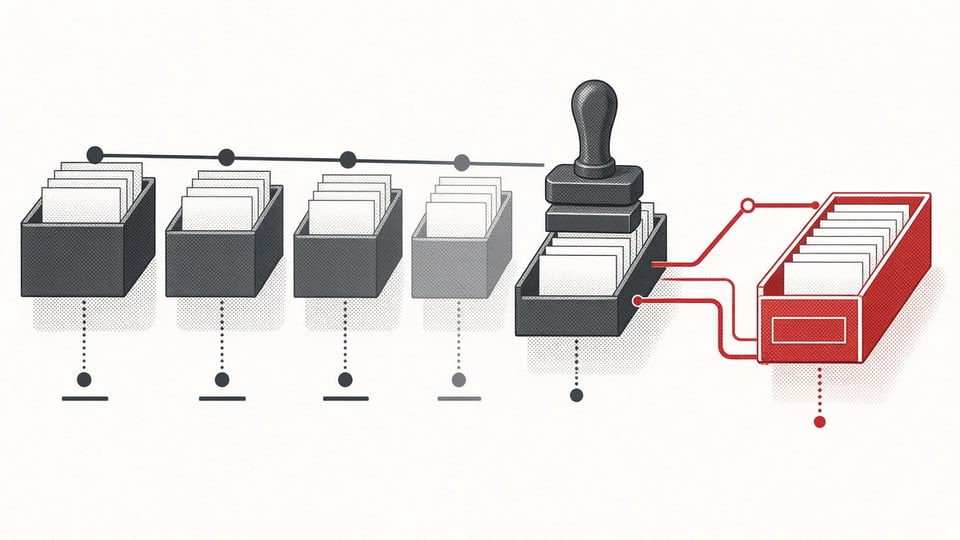
Orchestrate the deterministic layer. Leave the documents alone.
Intake, stages, calculations, the funding-cap register, housekeeping, outbound email. No reading. No deciding.
Workflow orchestration across the form tool, the CRM, iPaaS, and spreadsheets. Intake, stage progression, calculations, the funding-cap register, housekeeping, and outbound email when a task completed. Rules-based automation. It did not read documents, fuzzy-match entities, or decide reject or approve.

AI proposes. A human disposes.
Every AI verdict becomes a review task. The human still owns approve and reject.
The design principle is AI proposes, human disposes. Five highest-impact functions sit in case-flow order. About 20 iPaaS flows, a dozen scheduled or event jobs, and about two dozen CRM rules from Phase 1 sit underneath.


The unit of work changed.
The job stopped being "a case." It became "a verdict to review." A couple of minutes per review. Across one programme cycle, roughly one FTE of review workload. If the AI was right, mark the task done. That triggers the rejection email. If it was wrong, delete the task and mark the check passed.
Five checks. In case-flow order.
These are the highest-impact functions. They sit on top of the Phase 1 plumbing. AI proposes. A human confirms.
Entry gate
Registration document versus the name on the application.
Eligibility checks
The rules that decide whether the applicant can sit in the programme at all.
Document verification
OCR on the pack. The highest-volume verdict.
Decision communication
Rejection reason, written so the applicant can act on it.
Claim verification
Disbursement claims from partner vendors, after the application is already through.
Indexed Year 1 = 100.
Cost per case down 54% Year 1 to Year 2. Team −44%. Cases per FTE-month 2.2×. Margin +12.4 pp. AI proposes, human confirms.
−54%
Total cost and cost per valid case, both 100 → 46.
2.2×
Index 100 → 222.
+12.4 pp
77.2% → 89.6%. Net 100 → 116 (+16%).
100 → 56
−44%. Same operating window. Indexed Year 1 = 100.
100 → 123
+23%. Valid cases only.
100 → 222
+122%. 2.2×.
"Without AI" models Year 1 team size and operating allowance onto the Year 2 window. Revenue is unchanged. Savings come from staff and allowance. AI inference is about 20% of total cost under the AI setup.
| Line | Year 1 | Year 2 |
|---|---|---|
| Staff | 44 | 16 |
| Operating allowance | 56 | 21 |
| AI inference | 0 | 9 |
| Total cost | 100 | 46 |
| Cost per valid case | 100 | 46 |
| Revenue | 100 | 100 |
| Net | 100 | 116 |
| Margin | 77.2% | 89.6% |
| Net-to-cost | 3.4× | 8.6× |
What this number is, and is not.
- Without AI is a model, not a measured control. It applies Year 1 team size and operating allowance to the Year 2 window.
- Throughput uses valid cases only.
- Some automations were built and not enabled. They are not counted.
- Known testing issues: an occasional bank-statement false-invalid, and one missing rejection reason in a template. Human review caught both.
What I would run again.
Automate the deterministic layer first.
Phase 1 did not read a document or pick reject or approve. It still had to exist before AI was worth putting in the path.
Keep the human as the decision-maker, not the reader.
The review is a verdict, not a pack. A couple of minutes. Mark done, or delete the task and pass the check.
Concentrate on the highest-volume verdict.
Document verification / OCR is where the queue actually lives. Entry gate and eligibility matter. This is the volume.
Instrument every check.
If you cannot see a false-invalid, you cannot defend the number on Monday.
Build for the false path.
The AI will be wrong. Deleting the task and marking the check passed has to be a first-class move, not an afterthought.
Got a high-volume queue that still needs a human on the line?
Discovery is how we see whether AI-assisted processing is worth putting in front of a reviewer, or whether the deterministic layer is still the next job.